
How Giftedness Sometimes Leads to Existential Dread
While there’s no universal definition of “giftedness” in Canadian psychology, people generally perceive a gifted child as “exceptionally bright” with abilities above their peers in one or multiple areas.
Often described as “intense” in psychological literature, gifted children tend to be curious and eager learners. But what happens when this curiosity is not properly satisfied? Or worse, when it’s seen negatively?
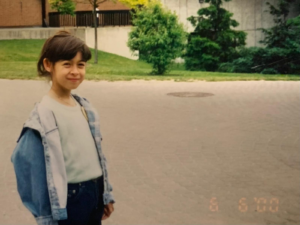 This is me at age 7. Cute, I know. For as long as I could remember, I loved to read and learn. So much so that by grade 3 or 4, I had reached the literacy level equivalent to a 10th grader. This meant that I’d soon seek out books for grade levels well above my own. Excited at all I had learned, I would want to share it with anyone who would listen. The problem? The more I wanted to share, the more people began to perceive me as a “know-it-all.”
Discouraged and embarrassed, I stopped sharing my interests with others, and had a lot of difficulty making friends. Not only this, but my constant learning meant that I became very idealistic. I dreamed of a world based on what I perceived as just and fair.
But the more I questioned the status quo, the more I was perceived as either a “killjoy” or a “shit disturber.” People got tired of me asking “why” to statements like “that’s just the way it is.”
So at a very young age, I learned that I had one of two options: hide my abilities to blend in (at the cost of my authenticity) or continue to learn and question reality (at the cost of connection).
This led me to a deep sense of existential dread. Or, as we in existential analysis may call it, a complete lack of inner consent as it relates to my interactions with the world.
I could not be myself, not in my life or in the world, as doing so not only made other children feel insecure (through no intent of my own) but also made certain adults feel threatened by the intelligence of a child.
Thankfully, I’m now an adult and no longer care how others perceive my intelligence or desire to learn. But I know that many gifted adults still struggle with their experiences of giftedness. Some feel burnt out by the constant pressure they had as a child, and others feel like they’ve missed a chance to be something “great” due to their early identified giftedness.
This is a large part of why I work with gifted and twice exceptional (2e) adults and hope to continue to create a space for them to feel seen and heard, without the bullshit.